Outline The
outline is the basis of the paper. And, the structure is the basis of an
outline. But without structure, it may
as well be a hoard of bullet points. First of all, the order of an outline is
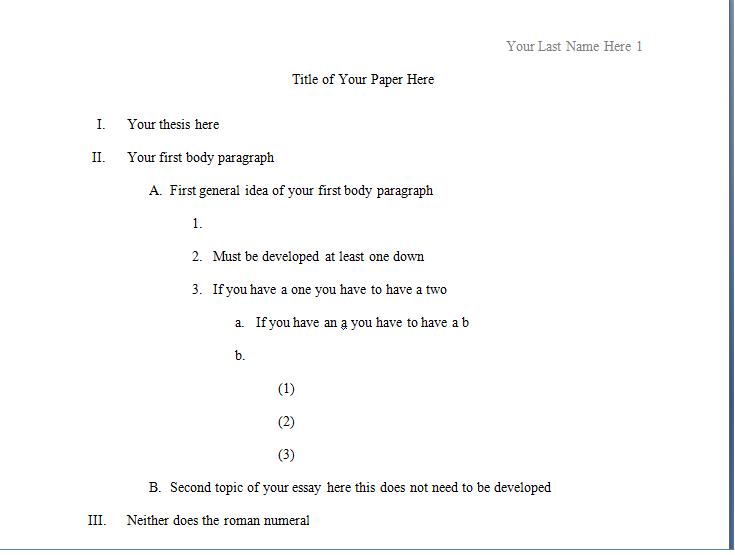
Roman numeral, capital letter, number, lower case letter, number in parentheses
and etc. The key to fast outlines is memorizing this format. And, there’s one
rule to always remember, if you have an A you have to have a B, if you have a 1
you have to have a 2. To clarify, this means that each entry you specify must be
sub developed at least two entries. However, there are some exceptions to this
rule. If I put: II. Environmental problems then I put A. Trash in ocean and
developed it down to 1. and 2. but then I put B. Trash in towns I wouldn’t have
to develop it. Though if I developed B. to 1. I would have to find a 2. That is
perfectly acceptable, as long as you keep the rule in mind. To be put simply, roman numerals and capital
letters are the only exception to this rule. Even though each entry in your
outline is a sentence, your outline entries are the basic ideas of those
sentences, they should be short phrases. Keep in mind that they are short
phrases only expressing the main ideas of your sentences. You will be directly
writing your essay from your outline, so editing it is crucial. Though
structure of the outline, how it looks is important, what you put in it is
important as well. Your outline may look stellar, but everything in it could be out of order or junk without learning the content of the outline. You have learned how to set up your outline, but you have no idea where to start with the content. The roman numeral of your essay is your thesis it is not your TS one, Roman numeral two is TS 1. And each entry is a sentence in your essay, as you already know. In your outline they are sentences expressed in the most basic idea possible. When creating your basic outline, there will be many gaps in your outline you will later fill those gaps with research. But, always remember, it isn’t good to wander from subject to subject. Keep one main focus for each set of sentences. Then, slowly transition to the next. In addition, using everyday topics can make your argument stronger, because you are giving the reader a more realistic view. Avoid straying from your topic when you use the comparisons though. To “top it off” I end my paragraphs with what I call a closing sentence, basically closure summarizing all that I’ve written. WARNING: DO NOT OUTLINE YOUR INTRODUCTION OR CONCLUSION. You keep your outline up to date; you will have to edit it constantly. As the hours go by, you’ll add more information that seems useful to you which is perfectly fine. You will edit your outline over and over again, you may even edit while translating your outline to an essay, and it’s never ending. Now let’s get to the actual writing, shall we? You’ve spent hours on your outline
and now you are exhausted, you’ve practically given up and decided to move on
to the next step. The pro of writing an outline for your essay is that writing
the actual essay will be a walk in the park. Most of you will do very basic
ideas in your outline. I do my outlines a bit differently; I make mine a bit
more specific so that the actual translation is easier. I am not suggesting you
do it the same way; I just need to be efficient in quantity and quality to keep
up with Mr. Carney’s extensive demands. And yes, if you are asking I did write
this when I was a student. Review, each entry is a sentence. Your outline
contains those ideas. They are plain ideas, and like raw meat they need to be
marinade and cooked. Again most of you won’t use the exact same process I use.
Because of my experience, I look at an entry and there I have a sentence
immediately. To begin, see it as a simple sentence than specify it step by
step. With much practice, you’ll soon be able to do this process in your
head. But, with just an essay written,
there are many gapes in your stairs. Example of outline below Outline Worksheet Downloads on the upper right hand corner. Websites: http://owl.english.purdue.edu/owl/resource/544/01/ http://owl.english.purdue.edu/engagement/index.php?category_id=2&sub_category_id=2&article_id=55 For an example for outlines you may view my 3rd paper outline (Also on the upper right hand side of the page)
 |
|
MLA/APA Writing |


This free website was made using Yola.
No HTML skills required. Build your website in minutes.
Go to www.yola.com and sign up today!
Make a free website with Yola
